
Georgia-Pacific Supervisor: Investing in the Development of Early-Career Engineers
July 30, 2024
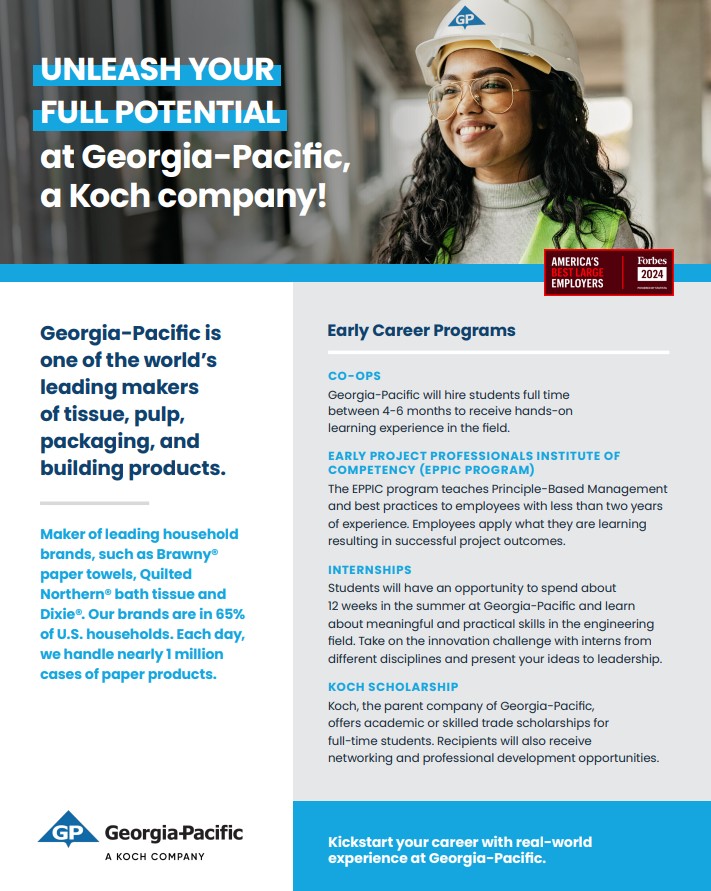
Atlanta - At Georgia-Pacific, employee development goes beyond day-to-day job training. It also involves cultivating a culture of continuous learning and personal growth. Investing in employees benefits them individually and contributes to the success of the organization. At Georgia-Pacific, we offer many early career programs that provide opportunities to create value for the company, including the Early Project Professionals Institute of Competency (EPPIC) program. Ben Klemp, engineering manager at Consumer Products Green Bay, Broadway and a Georgia-Pacific employee for 10 years, is a great example of developing early career employees while also creating a supportive work environment. Read more about Klemp’s career and the guidance he’s received at the company in various roles and levels of responsibility.
Describe your career path at Georgia-Pacific and your current role.
I graduated college in 2013 and was hired for an HVAC project engineering role in Georgia-Pacific’s consumer products corporate engineering group. That role included supporting the HVAC scope of larger projects and managing a few smaller projects. In 2019, I transitioned to a working manager role leading a group of project engineers executing smaller projects in our Paper and Secondary Fiber technology center. In 2021, I began my current role leading our Projects and Capabilities team, which presently includes eight engineers.
How are you being fulfilled in your work at Georgia-Pacific?
As a leader, the opportunity to invest in early-career engineers and be part of their developmental journey is very fulfilling for me. I’m also motivated by stewardship initiatives and have been able to work on energy-saving, emissions reduction, dust collection, and thermal comfort projects, which have benefitted Georgia-Pacific employees and the communities where we operate. My supervisors have also worked with me to identify opportunities to contribute while also maintaining work/life balance – especially when it comes to travel.
How have supervisors in your previous roles challenged and developed you?
I've had great supervisors at Georgia-Pacific who have given me opportunities and listened to my suggestions. One example is when my supervisor gave me the chance to manage my first project, even though I was new and inexperienced. She encouraged me to try and paired me with more experienced engineers to mentor me.
Another time, my supervisor informed me about a co-op student joining our group and offered me the opportunity to mentor her. With guidance and feedback from my supervisor, I worked closely with the student and helped her make progress in her career. She is now in an operations leadership position.
How do you make time for development and provide opportunities for your team members to grow?
Often, I find that our best learning comes from the project work that we do. I try to think strategically about all project assignments and look for new learning opportunities while also building upon demonstrated skills and knowledge and each employee’s comparative advantage.
I also encourage team members to devote time to educational development – generally in the range of one hour per week (a technical webinar, for example) and one week per year (more in-depth training).
Could you provide an example of how you support employee development through training, skill enhancement, or by assigning stretch tasks?
A recent new hire to my group expressed interest throughout the recruitment process in project-based work. As we began preparations for her onboarding and skill development, I was made aware of a pilot program forming which intended to formalize project management skill development. This program became known as EPPIC (Early Project Professional Institute of Competency).
On her first day, she met with the leader of the EPPIC program and a motivation partner. Within her first few weeks, she ramped up to full EPPIC participation. We discussed EPPIC in one-on-ones to reinforce its importance, apply learnings to project work, and gather feedback on the program – to learn organizationally through the pilot. She graduated from the program and was identified as an EPPIC mentor for the next cohort.
Describe the EPPIC program and early career opportunities for engineers within Georgia-Pacific.
EPPIC stands for Early Project Professional Institute of Competency. The program is intended to equip project professionals with the foundational knowledge and skills required for effective project work in a structured format through the apprenticeship model.
Our EPPIC learners have expressed several benefits from involvement in this program including:
- Relationship building with other early career project professionals.
- Networking with company leadership and key support personnel.
- Visibility to opportunities supporting other projects and outages.
- Self-driven optional assignments which allow the learner to apply, practice, and create value on real projects.
What’s your advice to supervisors as they look for ways to grow their team’s skill sets and make sure they are fulfilled at work?
I’d recommend that supervisors consider both the team needs and the individual’s interests and demonstrated ability when selecting assignments. I’d also recommend discussing potential assignments with the individual openly (vs. making an assignment). Giving my team members an opportunity to participate in the decision has improved ownership and outcomes.
Is there anything else you would like to add to your experience?
Having honest conversations with supervisors is very important. Even though these conversations can be uncomfortable, in the end supervisors appreciate the discussion and it ultimately leads to building trust, clarifying expectations and sharing ideas and solutions.
Share this article